History
Difficulties arise in tracing the history of design management. Even though design management as an expression is first mentioned in literature in 1964, earlier contributions created the context in which the expression could arise. Throughout its history, design management was influenced by a number of different disciplines: architecture, industrial design, management, software development, engineering; and movements such as system theory, design methodologies. It cannot be attributed directly to either design or to management.
Businessedit
Managing product aesthetics and corporate design (early contributions)edit
Early contributions to design management show how different design disciplines were coordinated to achieve business objectives at a corporate level, and demonstrate the early understanding of design as a competitive force. In that context, design was merely understood as an aesthetic function, and the management of design was at the level of project planning.
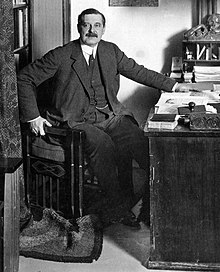
The practice of managing design to achieve a business objective was first documented in 1907. The Deutscher Werkbund (German Work Federation) was established in Munich by twelve architects and twelve business firms as a state-sponsored effort to better compete with Great Britain and the United States by integrating traditional craft and industrial mass-production techniques. A German designer and architect, Peter Behrens, created the entire corporate identity (logotype, product design, publicity, etc.) of Allgemeine Elektrizitäts Gesellschaft (AEG), and is regarded as the first industrial designer in history.citation needed His work for AEG was the first large-scale demonstration of the viability and vitality of the Werkbund's initiatives and objectives and can be considered as first contribution to design management.
In the following years, companies applied the principles of corporate identity and corporate design to increase awareness and recognition by consumers and differentiation from competitors. Olivetti became famous for its attention to design through their corporate design activities. In 1936 Olivetti hired Giovanni Pintori in their publicity department and promoted Marcello Nizzoli from the product design department to develop design in a comprehensive corporate philosophy. In 1956, inspired by the compelling brand character of Olivetti, Thomas Watson, Jr., CEO of IBM, retained American architect and industrial designer Eliot Noyes to develop a corporate-wide IBM Design Program consisting of coherent brand-design strategy together with a design management system to guide and oversee the comprehensive brand identity elements of: products, graphics, exhibits, architecture, interiors and fine art. This seminal effort by Noyes, with his inclusion of Paul Rand and Charles Eames as consultants, is considered to be the first comprehensive corporate design program in America. Up to and during the 1960s, debates in the design community were focused on ergonomics, functionalism, and corporate design, while debates in management addressed Just in time, Total quality management, and product specification. The main proponents of design management at that time were AEG, Bauhaus, HfG Ulm, the British Design Council, Deutscher Werkbund, Olivetti, IBM, Peter Behrens, and Walter Paepcke.
Managing design systematically (1960s–1970s)edit
The work of designers in the 1960s was influenced by industry, as the debate on design evolved from an aesthetic function into active cooperation with industry. Designers had to work in a team with engineers and marketers, and design was perceived as one part of the product development process. In the early years, design management was strongly influenced by system science and the emergence of a design science (e.g. the "blooming period of design methodologies" in Germany, the US, and Great Britain), as its main contributors had backgrounds in architecture. Early discussions on design management were strongly influenced by Anglo-Saxon literature (e.g. Farr and Horst Rittel), methodological studies in Design Research (e.g. HfG Ulm and Christopher Alexander), and theories in business studies. Design management dealt with two main issues:
- how to develop corporate systems of planning aims
- how to solve problems of methodological information processing
Instruments and checklists were developed to structure the processes and decisions of companies for successful corporate development. In this period the main contributors to design management were Michael Farr, Horst Rittel, HfG Ulm, Christopher Alexander, James Pilditch, the London Business School, Peter Gorb, the Design Management Institute, and the Royal Society of Arts. Debates in design disciplines were focusing on design science, design methodology, wicked problems,note Ulm methodology, the relationship of design and business, new German design, and semiotic and scenario technique.
Managing design as a strategic asset (1980s–1990s)edit
In the 1980s several managers realized the economic effect of design, which increased the demand for design management. As companies were unsure how to manage design, there was a market for consultancy; focusing on helping organizations manage the product development process, including market research, product concepts, projects, communications, and market launch phases—as well as the positioning of products and companies.
Three important works were published in 1990: the Publication of Design Management – A Handbook of Issues and Methods by Mark Oakley (Editor), the book Design Management by French researcher Brigitte Borja de Mozota, and the Publication of Design Management – Papers from the London Business School by Peter Gorb (Editor). This new method-based design management approach helped to improve communication amongst technical and marketing managers. Examples of the new methods included trend research, the product effect triad, style mapping, milieus, product screenings, empiric design methods, and service design, giving design a more communicative and central role within organizations.
In the management community the topics of management theory, positioning strategy, brand management, strategic management, advertisement, competitive strategy, leadership, business ethics, mass customization, core competencies, strategic intent, reputation management, and system theory were discussed. Main issues and debates in design management included the topics of design leadership, design thinking, and corporate identity; plus the involvement of design management at the operational, tactical, and strategic levels.
In 1980 Robert Blaich, the senior managing director of design at Philips, introduced a design management system that regards design, production, and marketing as a single unit. This was an important contribution to the definition of design as a core element in business. At Philips Design, Stefano Marzano became CEO and Chief Creative Director in 1991, continuing the work of Robert Blaich to align design processes with business processes and furthering design strategy as an important asset of the overall business strategy.
Upon being appointed corporate head of the IBM Design Program in 1989, Tom Hardy, initiated a strategic design management effort, in collaboration with IBM design consultant Richard Sapper, to return to the roots of the IBM Design Program first established in 1956 by Eliot Noyes, Paul Rand and Charles Eames. The intent was to reprise IBM's brand image with customer experience-driven quality, approachability and contemporary product innovation. The highly successful IBM ThinkPad was the first product to emerge from this strategy in 1992 and, together with other innovative, award-winning products that followed, served to position design as a strategic asset for IBM's brand turnaround efforts initiated in 1993 by newly appointed CEO Louis V. Gerstner, Jr.
As a consultant following his 22-year tenure at IBM, Hardy served as Corporate Design Advisor to Samsung from 1996 to 2003 where his introduction of a new brand-design ethos and guiding principles, together with a comprehensive design management system, became a strategic corporate asset that significantly helped elevate Samsung's image from follower to global brand-design leader and dramatically increased brand equity value.
Managing design for innovation (2000s–2010s)edit
Design management has taken a more strategic role within business since 2000, and more academic programs for design management have been established. Design management has been recognized (and subsidized) throughout the European Union as a function for corporate advantage of both companies and nations.note The main issues and debates included the topics of design thinking, strategic design management, design leadership, and product service systems. Design management was influenced by the following design trends: sustainable design, inclusive design, interactive design, design probes, product clinics, and co-design. It was also influenced by the later management trends of open innovation and design thinking.
Notion of the term "design management"edit
In 1965 the term design management was first published in a series of articles in the Design Journal. This series includes a pre-publication of the first chapter of the book Design Management by Michael Farr, which is considered as the first comprehensive literature on design management. His thoughts on system theory and project management led to a framework on how to deal with design as a business function at the corporate management level by providing the language and methodology to effectively manage it.
The term "architectural management" was coined by the architects Brunton, Baden Hellard and Boobyer in 1964 where they highlighted the tension and synergy between the management of individual projects (job management) and the management of the business (office management). Although they did not use the term "design management", they stressed identical issues; while the design community discussed methodologies for design. Christopher Alexander's work played an important role in the development of the design methodology, where he devoted his attention to the problems of form and context; and focused on disassembling complex design challenges into constituent parts to approach a solution. His intention was to bring more rationalism and structure into the solving of design problems.
Design Policy (up to 2000s)edit
Design policies have a history reaching back to the end of the 19th century, when design programs with roots in the crafts sector were implemented in Sweden (1845) and Finland (1875). In 1907 the Deutscher Werkbund (German Work Federation) was established in Munich to better compete with Great Britain and United States. The success of the Deutscher Werkbund inspired a group of British designers, industrialists and business people after they had seen the Werkbund Exhibition in Cologne in 1914, to found the Design and Industries Association and campaign for a greater involvement of government in the promotion of good design. In 1944 design management by managing design policies was used by the British Government. The British Design Council was founded by Hugh Dalton, president of the Board of Trade in the British wartime government, as the Council of Industrial Design with the objective "to promote by all practicable means the improvement of design in the products of British industry".
Germany also realized the national importance of design during World War II. Between 1933 and 1945 Adolf Hitler used design, architecture and propaganda to increase his power; shown through the annual Reichsparteitage in Nürnberg on September 5. Heinrich Himmler coordinated several design activities for Hitler, including: the all-black SS-uniform designed by Professor Karl Diebitsch and Walter Heck in 1933; the Dachau concentration camp, designed by Theodor Eicke, and prototypes for other Nazi concentration camps; and the Wewelsburg redesign commissioned by Heinrich Himmler in 1944.
Since the 1990s the practice of design promotion evolved, and governments have used policy management and design management to promote design as part of their efforts of fostering technology, manufacturing and innovation.
Promotion and conference (till 2000s)edit
In America the Chicago industrialist Walter Paepcke, of the Container Corporation of America, founded the Aspen Design Conference after World War II as a way of bringing business and designers together – to the benefit of both. In 1951 the first conference topic, "Design as a function of management", was chosen to ensure the participation of the business community. After several years, business leaders stopped attending because the increased participation of designers changed the dialogue, focusing not on the need for collaboration between business and design, but rather on the business community's failure to understand the value of design.
The Royal Society of Arts (RSA) Presidential Medals for Design Management were instituted in June 1964. These were to recognize outstanding examples of design policy in organizations that maintained a consistently high standard in all aspects of design management, throughout all industries and disciplines. With these awards the RSA introduced the term design management. In 1965 the first medals were given to four companies; Conran & Co Ltd, Jaeger & Co Ltd, S. Hille & Co Ltd and W. & A. Gilbey Ltd. in the category "current achievements" and two companies London Transportnote and Heal and Son Ltd.note in the category "long pioneering in the field of design management". The medal selection committee included representatives of the RSA council and the faculty of Royal Designers for Industry.
The Design Management Institute (DMI) was founded in 1975 at the Massachusetts College of Art in Boston. Since the mid-1980s the DMI has been an international non-profit organization that seeks to heighten the awareness of design as an essential part of business strategy, and become the leading resource and international authority on design management. One year later the first conference was organized. The DMI increased its international presence and established the "European International Conference on Design Management" in 1997, and a professional development program for design management.
In 2007 the European Commission funded the Award for Design Management Innovating and Reinforcing Enterprises (ADMIRE) project for two years, as part of the Pro Inno Europe Initiative, which is the EU's "focal point for innovation policy analysis, learning and development". The aim was to encourage companies – especially small and medium enterprises (SMEs) – to introduce design management procedures to; improve their competitiveness, stimulate innovation, establish a European knowledge-sharing platform, organize the Design Management Europe Award, and to identify and test new activities to promote Design Management.
Education (1970s on)edit
Teaching design to managers was pioneered at the London Business School (LBS) in 1976 by Peter Gorb (1926-2013), the first Honorary Fellow of the DMI and a long-standing Fellow of the RSA. Gorb had previously embedded design management in the Burton Retail Group before joining LBS where he later founded the Design Management Unit in 1982 (in collaboration with Charles Handy) which he led for over 20 years. In 1979 his talk at the RSA entitled Design and its Use by Managers provided a background introduction to the wide scope of design within industry and commerce, an appreciation of the power of design as a management resource, and advocated the teaching of design to managers. Gorb produced two books based on seminars at the Design Management Unit at LBS, Design Talks (1988) with Eric Schneider and Design Management: Papers from the London Business School (1990). Gorb is also remembered as introducing the concept of Silent Design, design undertaken by non-designers, in an influential paper with Angela Dumas (1987).
In 1991 the University of Art and Design Helsinki founded the Institute of Design Leadership and Management and established an international training program. The International Design Management Conference was organised in the same year by them.note In 1995 the Helsinki School of Economics (HSE), University of Art and Design Helsinki (TaiK), and University of Technology (TKK) cooperated to create the International Design Business Management Program (IDBM), which aims to bring together experts from different fields within the concept of design business management.
Researchedit
The first international research project on design management, the TRIAD research project, was initiated by Earl Powell, then president of DMI and the Harvard Business School in 1989. In the same year Earl Powell and Thomas Walton, Ph.D. developed the Design Management Review and DMI published the first issue. The publication is solely focusing on design management and has become the flagship publication of the discipline.
Design and design management have experienced different generations of theories. In its first generation design focused on the object, in the second on the process, and in the third on the user. Similar shifts can be seen in management and design management in almost parallel steps. For design management this has been illustrated by Brigitte Borja de Mozota, using Findeli's Bremen Model as a framework. Design management research organised itself into:
- Organisational studies: design in an economic sectornote or design in large firms, such as Philips or Olivettinote
- Descriptive studies of specific methods of design managementnote
It is difficult to predict where design management research is heading.


Comments
Post a Comment